A Practical Guide for Engineers, Panel Builders, and System Integrators
If you have spent any time designing a control panel or industrial enclosure, you have almost certainly asked yourself this question. DIN rail is one of those foundational components that tends to be taken for granted, yet selecting the wrong type or size can lead to mounting incompatibilities, wasted enclosure space, or a panel that simply does not meet the demands of its environment. Getting it right from the start saves time, money, and a significant amount of rework.
This guide walks through the most common DIN rail types, how to match them to your application, and how the right complementary components from trusted manufacturers like Hammond, Wieland Electric, and Marathon Power can bring your system together with confidence.
DIN rail takes its name from Deutsches Institut fur Normung, the German standards organization. Today the IEC 60715 standard governs the global specification for these mounting rails. While dozens of rail variations exist in the market, three profiles account for the vast majority of industrial applications.
The 35mm Top Hat rail, formally designated TS 35, is the dominant standard worldwide. Its symmetrical hat-shaped cross-section makes it compatible with an enormous range of snap-on components: terminal blocks, circuit breakers, power supplies, PLCs, relays, UPS modules, and much more. When component datasheets say “DIN rail mountable” without specifying further, they almost always mean TS 35.
Depth options: TS 35 comes in two depth variants. The 7.5mm deep version (TS 35/7.5) is the standard choice for most general-purpose panels. The 15mm deep version (TS 35/15) provides greater mechanical rigidity and is preferred in heavy-duty or high-vibration environments such as transportation, oil and gas, or large machine panels where heavier components are mounted.
The G-section rail, also called C-rail, measures 32mm wide and features an asymmetrical open-channel profile. It was historically used for larger contactors, motor starters, and switchgear. While newer designs have largely migrated to TS 35 compatibility, G-section rail remains relevant for retrofits and applications requiring high current-carrying accessories. If you are working with legacy equipment or a specific motor control application, verify your components against this profile before assuming TS 35 will fit.
At just 15mm wide, the TS 15 mini top hat rail is designed for space-constrained enclosures and smaller panel layouts. It is commonly found in building automation, HVAC control, and compact OEM equipment. Component compatibility is more limited than TS 35, so confirming compatibility with your specific devices is essential before specifying this rail.
| DIN Rail Type | Profile Size | Common Applications | Key Advantage |
| Top Hat (TS 35) | 35mm wide, 7.5mm or 15mm deep | PLCs, terminal blocks, circuit breakers, UPS, relays | Universal; most widely supported |
| G-Section (C-Rail) | 32mm wide | Older industrial controls, motor starters | High current capacity |
| Mini Top Hat (TS 15) | 15mm wide | Space-constrained panels, small enclosures | Compact footprint |
| Solid / Perforated | TS 35 variants | Any standard TS 35 application | Perforated aids cable management |
Beyond profile type, several practical factors should drive your selection.
Component compatibility: Always verify that every component you plan to mount specifies compatibility with your chosen rail profile. This sounds obvious, but in mixed-component panels it is easy to overlook a single relay or power supply that requires a different profile or rail width.
Enclosure width and layout: Measure your available horizontal space and account for end stops, sectional connectors, and any required clearance at enclosure walls. Leaving insufficient space at the ends of a rail can make installation and future servicing difficult.
Load weight and vibration: Heavier components or installations subject to vibration — such as mobile equipment, rail vehicles, or machining environments — benefit from the deeper TS 35/15 profile or a steel rail rather than aluminum. Steel rails provide superior rigidity under mechanical stress.
Material selection — steel vs. aluminum: Steel DIN rails offer greater strength and are preferred in high-load or vibration-prone applications. Aluminum rails are lighter and better suited for corrosive environments or installations where weight is a concern. Stainless steel is available for aggressive chemical or outdoor environments.
Perforation pattern: Perforated rails make it easier to route cables behind mounted components and can improve airflow in densely packed enclosures. Solid rails are simpler and slightly stronger, making them the default choice when neither cable routing nor airflow is a concern.
Cut length vs. standard length: Standard rails are available in common lengths (typically 1 meter), but many applications require custom cuts. Plan your cuts before ordering to minimize waste, and ensure you have the right tools or order pre-cut lengths when tolerances are tight.
Selecting the correct rail is only part of the equation. How the rail is mounted inside an enclosure matters just as much for long-term reliability and serviceability. Hammond Manufacturing’s RMAD Series DIN rail mounting accessories are engineered to simplify and secure that process.
Hammond’s RMAD Series provides a range of brackets, end stops, and mounting hardware specifically designed to work with standard TS 35 and G-section rails. The series is built with consistent tolerances and uses robust materials suited to industrial enclosures, helping engineers and panel builders avoid the frustration of misaligned rails, slipping end clamps, or hardware that simply does not fit.
For professionals building NEMA or IP-rated enclosures — whether for industrial automation, power distribution, or field-deployed control systems — having confidence in your rail mounting hardware is not optional. A rail that shifts under load or during shipping can damage mounted components or cause loose connections that are difficult to diagnose in the field.
Learn more about Hammond’s RMAD Series through Area51 Electronics: Mount DIN Rail Equipment with Confidence Using Hammond’s RMAD Series
Once your rail is installed and your primary components are mounted, the wiring infrastructure becomes the critical next layer. Wieland Electric has been a global leader in connection technology for over a century, and their DIN rail terminal blocks represent some of the most advanced and reliable solutions available for switch and distribution cabinets.
Wieland offers two primary terminal block families for DIN rail applications, each targeting a different set of wiring priorities. selos WTPN (terminal blocks with push-in connection) and selos WTN (terminal blocks with screw connection)
WTPN – PUSH- IN TECHNOLOGY: Fast, maintenance free, future proof
The WTPN series terminal blocks are based on modern push-in technology, enabling tool free, time saving wiring. High contact forces ensure vibration-resistant, durable, and maintenance-free connections – ideal for low voltage power distribution in a wide range of industrial applications.
WTN – SCREW CONNECTION TECHNOLOGY: Proven, Robust, Flexible
The new screw terminal blocks are true all-rounders. Thanks to their simple handling, the proven cage clamp connection is a universally applicable solution for all conductor types – and is widely used across the globe.
Explore Wieland DIN rail terminal blocks through Area51 Electronics: Wieland Electric’s DIN Rail Terminal Blocks
Many DIN rail panels house equipment that cannot tolerate even a momentary loss of power. PLCs mid-cycle, SCADA systems, process controllers, and industrial computers all represent loads where a power interruption causes more than inconvenience — it causes process failure, equipment damage, or safety events.
Marathon Power’s Sprint Series DIN Rail AC UPS addresses this directly. Designed to mount directly on a TS 35 DIN rail alongside the equipment it protects, the Sprint Series eliminates power quality issues including voltage dips and momentary outages. The unit uses the latest microcontroller technology and is rated for the harsh environments common in industrial automation and process control.
Key features that make the Sprint Series well-suited to industrial DIN rail panels include:
The Sprint Series mounts directly to standard TS 35 rail alongside PLCs, industrial computers, SCADA equipment, and process control apparatus. Because of its compact size and relatively low weight, it can also be installed directly on fabrication tools, CNC machines, 3D printers, and other automated equipment that requires protection against voltage dips and brief outages.
Marathon Power focuses specifically on OEM and niche industrial markets — automation, process control, test and measurement, medical, and traffic control — which means their UPS products are engineered to the standards those markets require rather than being adapted from consumer or light commercial designs.
Learn more about Marathon Power’s DIN Rail UPS solutions: Marathon Power DIN Rail UPS at Area51 Electronics | Marathon Power Official Product Page
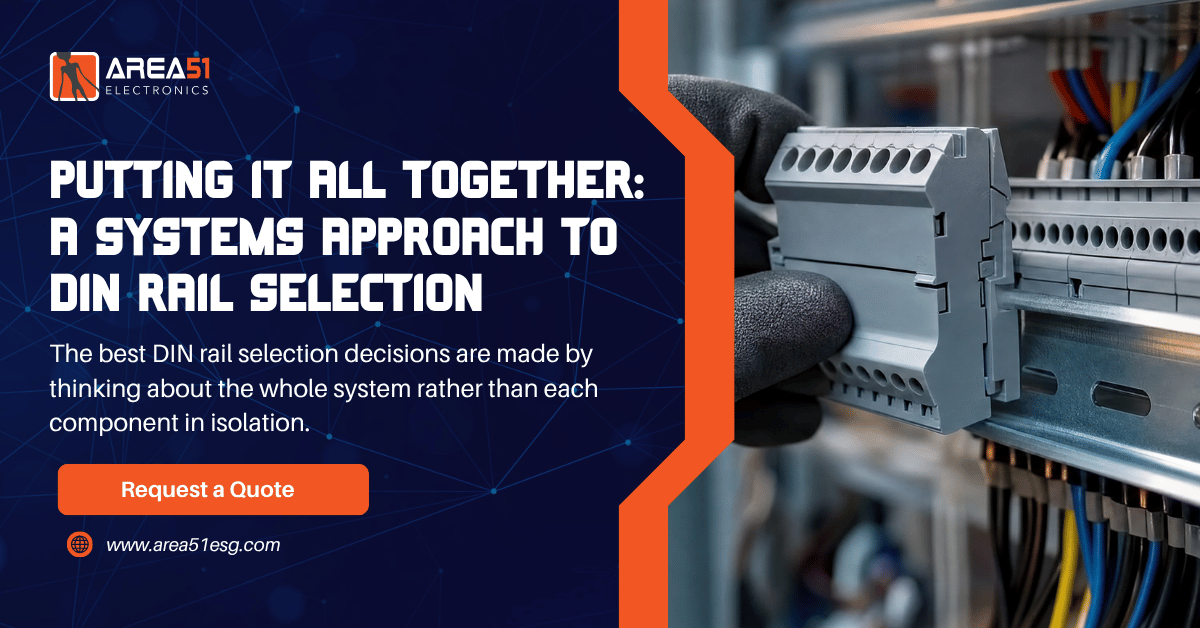
The best DIN rail selection decisions are made by thinking about the whole system rather than each component in isolation. Here is a practical framework for working through the question:
Step 1 — Inventory your components: List every device you plan to mount on the rail and confirm the mounting profile each one requires. If all devices specify TS 35, that is your rail. If any require G-section, plan accordingly or check whether an adapter is available.
Step 2 — Assess the environment: Consider temperature range, vibration, humidity, and any chemical exposure. High vibration pushes toward the 15mm deep TS 35 profile and steel construction. Corrosive environments point toward aluminum or stainless steel. Extreme temperatures affect both rail material choice and the battery technology in any UPS on the rail.
Step 3 — Measure and plan the layout: Sketch the panel layout before ordering. Confirm that your rail length, mounting hardware, and end stops will fit within the enclosure with adequate clearance. Account for the mounting footprint of larger components like a UPS module.
Step 4 — Select your wiring solution: Match your terminal block technology to your wiring environment. High-vibration applications benefit from tension clamp or push-in connections over traditional screw terminals. High-density panels benefit from the narrow-pitch push-in options Wieland offers.
Step 5 — Plan for power continuity: If any mounted device is critical, evaluate whether a DIN rail UPS belongs in the panel. The cost of adding power protection at design time is a fraction of the cost of downtime or data loss in the field.
Area51 Electronics is a global distributor of electronic, electrical, and electromechanical components — voted Top Electronics Distributor and recognized for supply chain excellence. As an authorized distributor, Area51 gives engineers and procurement professionals access to trusted manufacturers including Hammond, Wieland Electric, and Marathon Power, with the quality assurance processes that critical industrial applications require.
Whether you are building a single prototype panel or sourcing components for a production run, Area51’s team can help you identify the right DIN rail configuration, match compatible mounting hardware, and source the terminal blocks and power protection components your application demands.
Ready to specify your DIN rail solution?
Contact Area51 Electronics or submit a request for quote today.
area51esg.com/request-for-quote
Related Resources from Area51 Electronics
Hammond RMAD Series DIN Rail Mounting Accessories
Wieland Electric DIN Rail Terminal Blocks
Marathon Power DIN Rail UPS Systems
Marathon Power Sprint Series — Official Product Page
Wieland Electric Terminal Block Portfolio