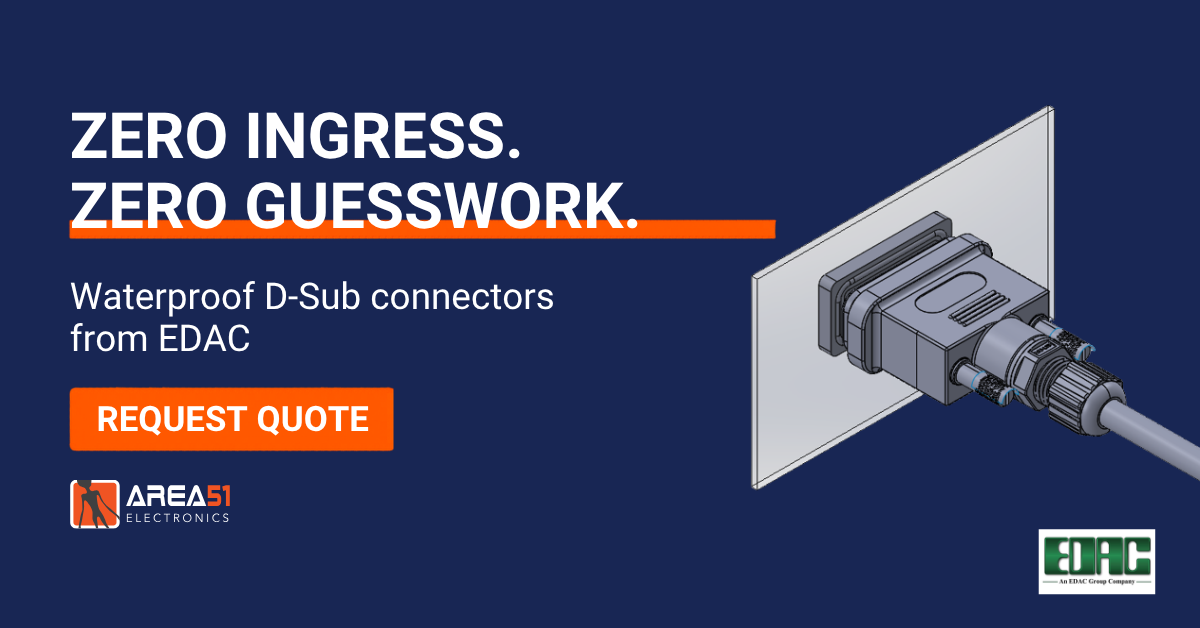
The network lives outdoors now. Here is how EDAC’s IP67-rated D-Sub series keeps the most familiar interface in electronics working on poles, rooftops, and roadside cabinets.
Telecom has spent the last decade moving hardware out of climate-controlled central offices and into the elements. Small cells on light poles, remote radio units on towers, fiber cabinets on street corners, and backhaul radios on rooftops all have one thing in common: they have to keep running through rain, condensation, dust, and temperature swings, often miles from the nearest technician.
In that kind of deployment, the connector is frequently the weakest link. A single interface that lets moisture creep into the housing can corrode contacts, trip alarms, and turn a routine weather event into a truck roll. That is exactly the problem EDAC set out to solve with its waterproof D-Sub connector series, and it is why we at Area51 Electronics are excited to put them in front of our telecom customers.
It is easy to assume the humble D-Subminiature has been replaced by newer interfaces, but walk through any piece of network infrastructure and you will still find it everywhere. D-Subs carry RS-232 and RS-485 console and management ports, dry-contact alarm interfaces, sensor and environmental monitoring lines, and auxiliary power in rectifier and battery backup systems. Engineers keep specifying them for good reasons: they are familiar, keyed, mechanically robust, and supported by an enormous ecosystem of cables and tooling.
The challenge is that a standard D-Sub was never designed to live outside. EDAC’s waterproof versions keep everything technicians already know about the format and add the environmental protection that outdoor telecom equipment demands.
EDAC has been designing and building interconnect solutions since 1966, giving it more than five decades of connector engineering experience. The company built its reputation on card edge and rack and panel connectors and has since grown into one of the broadest interconnect portfolios in the industry, spanning D-Sub, RJ45 and magnetic jacks, USB, HDMI, headers, spring-loaded pogo pins, inline connectors, cable assemblies, and fully custom designs.
That breadth matters to telecom designers. When a single supplier can cover the console port, the Ethernet jack, the power interface, and a custom cable, it simplifies qualification and keeps a bill of materials manageable. EDAC also holds IATF 16949 certification and is an ECIA member, both of which signal the kind of process discipline you want behind components headed into critical infrastructure.
TheseIP67-rated waterproof D-Subminiature connectors are in both standard and high density packages, with plugs and receptacles in 9, 15, 25, 26, 37, and 44 pin versions. High power combo configurations are available as well, so signal and power can share a single sealed interface.
What makes the sealing work is how EDAC builds it. Each connector is epoxy sealed using a specialized process that delivers zero ingress through the connector body. The process prevents wicking up the leads, a common failure path in lesser sealed connectors, and leaves a smooth molded finish with no air bubbles that could become leak paths over time. A solid silicone O-ring then seals the connector to the panel, closing off the gap around the cutout.
Under IEC 60529, the first digit “6” means the enclosure is fully dust-tight. The second digit “7” means it withstands temporary immersion in water up to 1 meter for 30 minutes. For outdoor telecom gear exposed to driving rain, standing water, snow melt, and airborne dust, that is a meaningful level of protection. As always, the rating applies to the connector as properly installed and sealed at the panel, so mounting and mating practices matter.
The series is organized by density and footprint, with matched plug and receptacle part families for each configuration.
| Series (M/F) | Density | Footprint | Contacts | Pitch (Contact x Row) |
| 627W / 628W | Standard | Vertical | 9 to 37 | 2.77 mm x 2.82 mm |
| 629W / 630W | Standard | Right Angle | 9 to 25 | 2.77 mm x 2.82 mm |
| 633W / 634W | High Density | Right Angle | 15 to 44 | 2.29 mm x 1.98 mm |
| 637W / 638W | High Density | Vertical | 15 to 44 | 2.29 mm x 1.98 mm |
Waterproof D-Sub connectors. Contact plating options range from gold flash up to 30µin gold.
| Series (M/F) | Power / Signal Contacts | Plating | Contact Codes | Flange Mtg. Options |
| 627WC / 628WC | 1 to 5 / 0 to 20 | Flash to 30µin gold | 12 Standard | 4 |
| 629WC / 630WC | 1 to 5 / 0 to 20 | Flash to 30µin gold | 12 Standard | 6 |
Waterproof power combo D-Sub connectors, with power contacts rated up to 40 amps.
Signal + Power in One: Power combo versions combine high power contacts up to 40 A with signal contacts in a single sealed connector, reducing panel cutouts and potential leak points.
Zero-Ingress Epoxy Seal: A specialized epoxy process eliminates lead wicking and air bubbles, paired with a silicone O-ring seal to the panel.
Grounding + Retention: Plug shell indents provide a grounding path and added mating retention, helping connections stay put under vibration and wind load.
Flexible Mounting: Threaded inserts and threaded standoffs, with or without boardlocks, plus an available bracket for right angle PCB mounting.
Termination Choices: PC tail for board-mount designs or solder cup for wired applications, in vertical and right angle orientations.
Sealed Cable Side Too: Waterproof hoods and overmolded cable assemblies extend protection to the mating side. Metal backshells add EMI and RFI shielding.
Anywhere a D-Sub interface has to face the outdoors, the series is worth a look. A few of the applications we see most often:
Outdoor Cabinets: Fiber distribution hubs, broadband and DSL cabinets, and roadside enclosures that need sealed alarm, sensor, and management interfaces.
Tower + Rooftop Gear: Remote radio units, microwave backhaul outdoor units, and tower-mounted equipment where a failed connector means a climb.
Small Cells + DAS: Pole-mounted and street-level 5G small cells and distributed antenna systems with tight space budgets, where high density versions shine.
Power + Backup Systems: Rectifiers, battery backup shelves, and power distribution in outdoor sites, where power combo versions consolidate power and monitoring lines.
Rural + Edge Deployments: Remote broadband and edge compute nodes in harsh or hard-to-reach locations, where uptime depends on eliminating moisture-related faults.
Field Test Interfaces: Sealed service and diagnostic ports that technicians can access in the field without compromising the enclosure.
With multiple densities, footprints, plating levels, and mounting options, it pays to think through a few questions before you lock in a part number:
Not sure which combination fits your design? That is exactly the kind of question our team is here to help answer.
Area51 Electronics is an authorized distributor based in Irvine, California, and we are proud to be listed among EDAC’s distributors. Buying through an authorized channel means genuine, factory-traceable parts backed by the manufacturer, with no guesswork about where your components came from. For telecom infrastructure that is expected to run for years in the field, that traceability is not optional.
Beyond the parts themselves, we bring hands-on product knowledge. Our team can help you compare series and configurations, cross-reference existing D-Sub designs to sealed alternatives, check availability and lead times, and connect you with EDAC for custom requirements. Whether you are prototyping a new small cell enclosure or ramping up a cabinet refresh, we want to make sourcing the easiest part of your project.
Contact Area51 Electronics for pricing, availability, datasheets, and application support on the full EDAC waterproof D-Sub lineup.

